
A Simple Guide to Buying a Beginner Flute
by Sarah Carrier
This post contains affiliate links. If you make a purchase, I may earn a commission at no extra cost to you.
Many parents ask me what flute they should buy for their child who is just starting out on the flute. As a longtime flute teacher and a parent of a young child, I would like to outline a few options for you to consider.
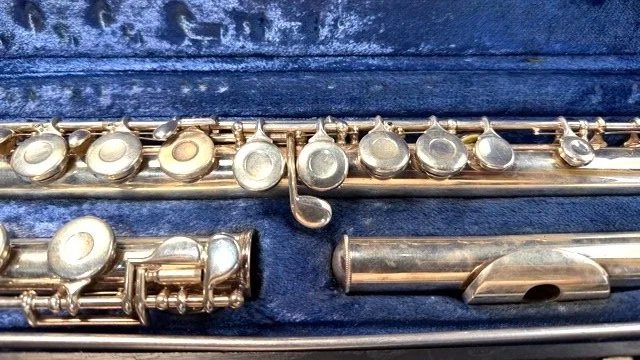
My legendary 32 year old Gemeinhardt 2SP
Flutes vs. “flute-like-objects”
If you aren’t already in the know when it comes to flute brands, there are enough choices out there to make your head spin. The key to making a successful purchase is to buy a flute that can produce a nice sound, will not need frequent repairs, is priced within your budget, and suits your child for the time being. In this article, I will list brands that I trust. They will still need adjustments here and there as well as a yearly professional cleaning (called a clean, oil, and adjust), but this comes from the normal wear and tear of owning any flute, especially when kids are involved.
There are brands of beginner flutes out there that are cheaper than my recommended brands and may have the capability of producing a decent sound. They might even last 2 years of play. However, if you are less fortunate, you could end up purchasing a flute that even a professional cannot get to play well, and is either unplayable from the start or becomes “totaled” after 6 months-1 year of play. These are what I call “flute-like-objects.” They have the same number of keys, but aside from that you don’t have much to work with. They might even have very fancy sounding names, using French or Italian names to trick you. I promise that I am not trying to fear-monger with these statements. I am simply trying to help you avoid the trap of buying a flute that is cheaper to repurchase than it is to repair (when it inevitably breaks). What a terrible waste! In the end, the child still has a crummy flute that will never produce a clear, crisp sound. Hopefully these tips will help you find a flute that is both within budget and worthy of your child’s efforts.
Renting
If your child has only recently shown interest in the flute and you aren’t sure if they’ll make it past the first month, by all means, rent a flute from your local instrument shop. Make sure the contract is month-to-month and ask if there is a rent-to-own program. That way, if you end up with a decent rental, your payments can go towards the purchase of that instrument.
Here’s my pro-tip: call up the shop beforehand and ask them what brands they have available for their rental program.
If they have any flutes by Yamaha, Jupiter, DiZhao, Trevor James, Gemeinhardt, or Pearl, then you have yourself some good options. Check their Google reviews too to see if there is any mention of the condition of the rental instruments when they are received.
If I was the customer in this scenario, my follow up question would be “do you have any new ones?” Try everything you can to have the store hand-select a nice flute that has not been rented out many times. If the store does not have any of the listed brands, but you still want to rent from them, I strongly suggest that you do not buy this rental at the end of the rental contract. 6 months in, a poorly made flute may have already gone through half of its life-span. Again, you would not believe how junky some of these instruments can be.
Buying new
As of 2026, if you have at least $500 to spend, you can buy a decent new beginner flute. These days your one good option at this price will be a Gemeinhardt 2SP. This was my first flute as a fifth grader and it got me into my district honor band in 6th grade. I played on it until upgrading to an intermediate model flute in 7th grade (which cost around 4 times the amount of my beginner flute!). While this isn’t my top pick for beginner brands, I would much rather see a new student come to their lesson with this flute than one of those “flute-like-objects.”
My top pick for a beginner flute, and I think the vast majority of flute teachers would agree, is a Yamaha 222. It is reliable, can easily produce a full and beautiful sound, and is straight-forward when it comes to repairs. The Con: price. It is astonishing to see how much the price of this flute has risen in recent years—to the point where you could buy a step-up (albeit from a different brand) for the same price. When well taken care of however, this flute can last. So even if your child wants to continue playing into high school, but never gets “serious” about it, they still have a good instrument to work with.
Other models I recommend for their quality and reliability are: Jupiter 700A, DiZhao 100, and Pearl 200.
If your child is 8 years old or younger (or if they are on the smaller side), you could also consider a flute with a curved headjoint which reduces the overall length. The Trevor James 10XC2 comes with both a straight and curved headjoint, so you don’t have to purchase a whole other flute when they grow out of the curved headjoint. Jupiter also makes curved headjoint flutes in a few models, including the 700WRE (has a special feature called a split E, which makes a certain pesky high note easier to play), 700WE (no split E), and 700WD (the shortest option for the youngest and smallest players, but it has a more limited range). The straight headjoint must be purchased separately.
One more thing—buy from a reputable flute dealer. You might notice for example, that you can buy the Yamaha 222 on Amazon for a much lower price. However, this flute is for the “international market” which means grey market, thus outside of the Yamaha supply chain. You will NOT be eligible for Yamaha’s 5 year warranty, it will come in a softer case (making it at significantly greater risk to damage), and it could even be counterfeit.
The linked flutes that I listed are all sold by Flute Center, one of the top flute retailers in the world. Feel free to check out not only their flutes, but their sheet music and accessories. You can use my code HEYFLUTES at checkout to receive 10% off sheet music and 5% off accessories.
Buying used
If you are willing to hunt, there are many excellent flutes to be had in the used market. Reverb, Ebay, Mercari, and Facebook Marketplace are all tried and true options. There is of course a serious risk to buying a used flute, especially when you are not able to test the flute yourself. My recommendations are to: 1) shop local and 2) get proof that the flute is in good working condition. By shopping locally, you have the opportunity to make sure that the flute works before buying it. It might in fact be worth your while to hire a local flute teacher to go with you to the seller location. Send them the listing first to see if they think that it looks promising or if anything looks amiss right off the bat.
If you want to avoid a face-to-face transaction and are looking on Ebay, just beware of listings that say things like “16 hole C-flute” (who’s counting the holes?), “Yamaha pads” (this is a really sneaky one), or “as is” (we all know what that means). And on a site like Ebay, if it sounds too good to be true, it probably is. Don’t say I didn’t warn you.
In summary, don’t just buy any flute when your kid first picks up the instrument. It’s easy to say “I’ll get a better one when they show me that they are dedicated,” but how can you reasonably expect them to progress when their instrument is faulty to begin with? I can tell you that they stand a much better chance at falling in love with the flute when they have a reliable instrument that is in good condition.